
 https://www.flickr.com/people/aloha75/ on Wikimedia
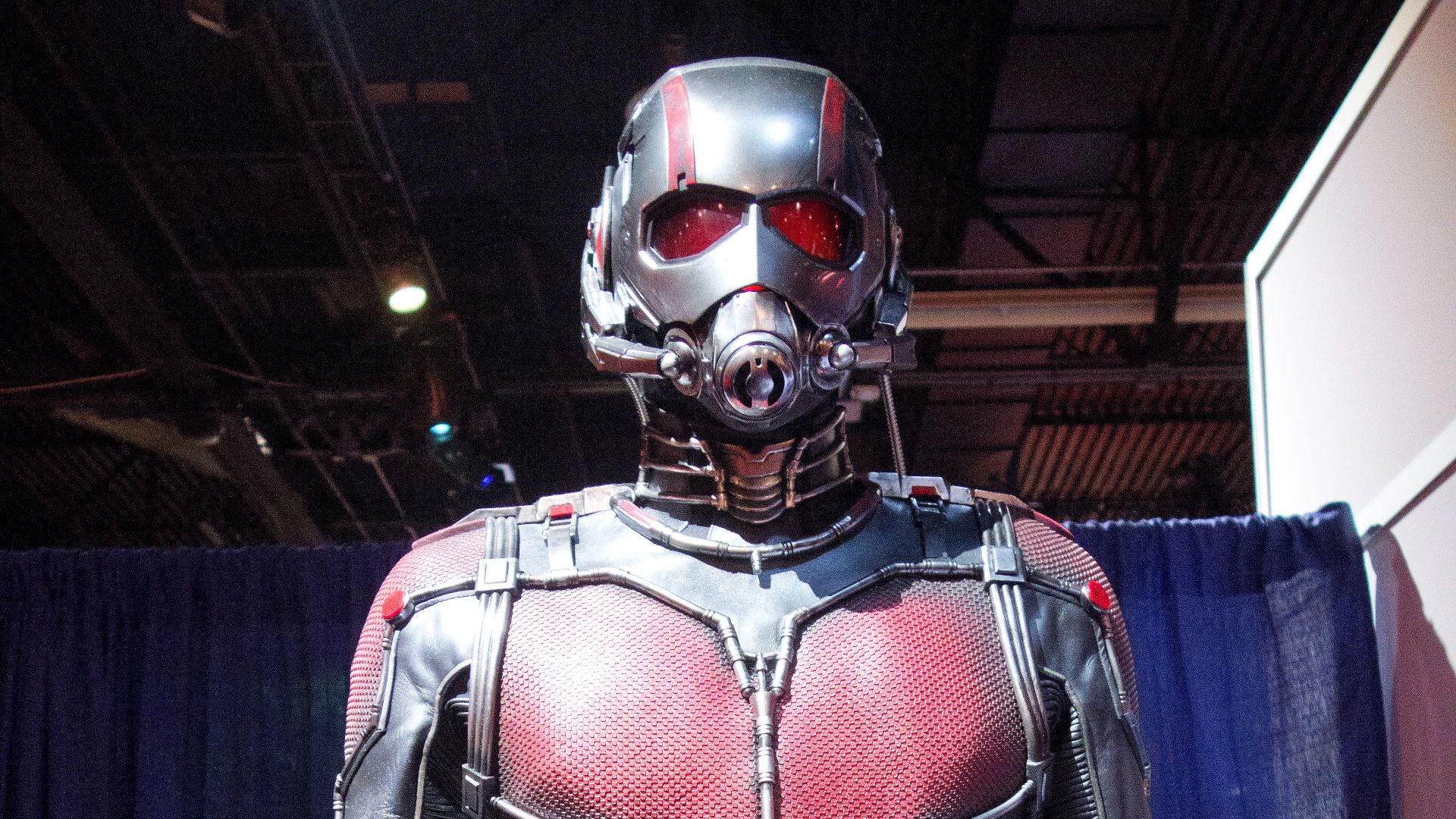
Ant-Man shrinks without getting any lighter. That isn't a fan theory or a continuity error. It's the stated premise, since Pym particles work by changing the spacing between atoms rather than by taking matter away, and keeping his mass is the whole reason a man the size of an ant can hit like a full-grown adult. The films stay consistent about it.
Hold onto that mass for a moment, though, and the rest of him falls apart. A 2020 student physics paper ran the arithmetic on an 86-kilogram Scott Lang shrunk from about 1.8 meters down to 12.7 millimeters, and the numbers go strange in a hurry. His growing power has a separate problem, one that has been understood since 1638, and the hand-waves meant to patch over both create a third.
Keeping His Mass Makes Him Denser Than Any Solid
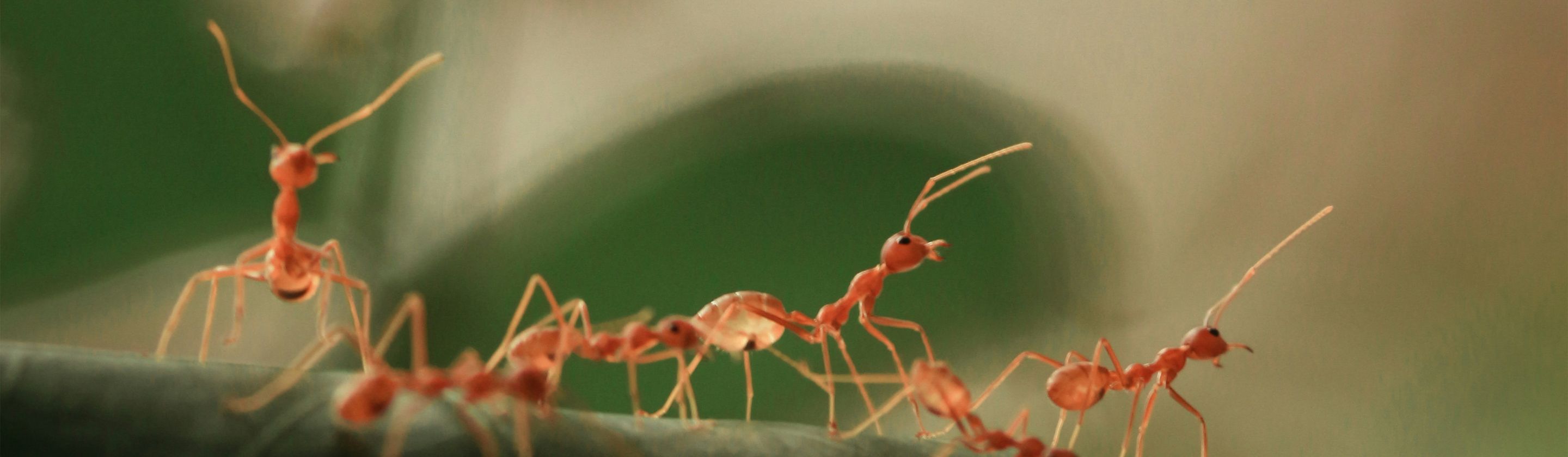
At full size Scott's body runs around 1,300 kilograms per cubic meter, which is roughly what a person should be. Squeezed to 12.7 millimeters with every kilogram preserved, he lands near 3.6 billion kilograms per cubic meter. That figure belongs to collapsed stars rather than to anything you could pick up. Real small animals go the other way, shedding weight faster than they shed strength, which is why an ant can haul many times its own body.
Pressure under his feet follows the density, reaching about 840 million newtons per square meter when he's small, against roughly 42,000 at normal height. Standing on a kitchen counter, he'd go straight through it. The payoff is the punch, which packs a grown man's energy into a contact patch the size of a pinhead and arrives more like a bullet. At giant size the same energy spreads out and does proportionally less.
Almost every scene he appears in needs the opposite to be true. He rides on the back of a flying ant and gets flicked across rooms. He lands on flowers without flattening them and sits lightly atop windowsills. A man built like a white dwarf star shouldn’t be able to manage any of that.
Growing Runs Into a Rule From 1638
Galileo recognized that when an object gets bigger, its weight increases faster than its strength. Double its size, and the cross-sectional area supporting it increases fourfold, but its weight increases eightfold. The larger object is therefore carrying more weight relative to what can support it. This applies to buildings, bridges, and animal bones alike. Living things are bound by the same physical rules as everything else.
His own example was a wooden beam. Make it ten times larger in every dimension and it gets a hundred times stronger, while a load scaled the same way gets a thousand times heavier. The large beam therefore carries about a tenth of what the small one managed. Push the scale far enough and a beam can't support itself, never mind anything resting on top of it.
At roughly 65 feet tall, Giant-Man is more than ten times the height of an ordinary man. If his proportions stay the same, his bones gain about 100 times the cross-sectional area, but his body becomes roughly 1,000 times heavier. His skeleton simply cannot support that much extra weight. Galileo recognized that large animals need proportionally thicker bones for this reason. A human scaled up without changing his proportions would collapse under his own weight. Galileo applied the same reasoning to a fly enlarged tenfold, concluding that it would be too heavy to stand or fly.
Every Fix Introduces a New Problem
Shrinking something by squeezing the empty space inside its atoms sounds possible, but there's a problem: electrons resist being packed closer together, creating a pressure that increases as matter becomes denser. At extreme densities, this becomes electron degeneracy pressure, the same effect that helps keep white dwarf stars from collapsing. Even if shrinking were possible, the mass wouldn't disappear. A ten-story building reduced to a fraction of its size would still weigh tens of thousands of tons, concentrating all that weight on a tiny patch of ground.
His eyes fail for unrelated reasons. Visible light stays about half a micrometer long however small you get, and a pupil focuses properly only while it spans thousands of wavelengths. Shrink it toward that wavelength and light scatters instead of forming an image. The view also dims by the square of however far he shrinks, so he'd need absurd floodlighting to see at all.
Marvel hired Caltech quantum physicist Spyridon Michalakis to advise on the films, but even he acknowledged that shrinking was one of their bigger scientific stretches. A person reduced to insect size would struggle to breathe and maintain body temperature. The closest real-world comparison he offered was muonic matter, in which particles about 200 times heavier than electrons replace electrons in atoms, allowing them to become much smaller. Scientists can briefly produce this kind of matter in particle accelerators, but it lasts only microseconds.