
Powering the Physical World with Pixels
We often view video games as pure escapism, a way to disconnect from reality and lose ourselves in digital playgrounds. However, the boundary between our virtual adventures and actual technological progress is incredibly thin. Over the past few decades, the massive demands of the gaming industry have consistently forced engineers to solve incredibly complex hardware and software problems.

1. Training AI Models with Graphics Cards
Modern artificial intelligence tools like ChatGPT and sophisticated machine learning models owe their entire existence to gamers who wanted smoother frame rates. Every time you ask Alexa to add something to your grocery list or Google Home to play your favorite song, you’re benefiting from years of gaming-inspired natural language UI design.

2. Standardizing the Modern Social Web
Wire routing inside every tech product you own has been minimized thanks to years of game console motherboard design. Game consoles proved to the early tech industry that millions of people were eager to socialize, trade, and collaborate within digital communities. The social web you navigate today is built directly on top of the infrastructure these early players pioneered.

3. Controlling Military Machinery with Gamepads
You might expect a multi-billion-dollar military vehicle to use highly custom, incredibly complex command interfaces. Instead, the United States Navy and various ground forces actively use standard, off-the-shelf Xbox controllers to operate high-tech submarine periscopes and ordnance disposal robots.

4. Improving Surgeon Precision via Laparoscopy
When doctors perform minimally invasive laparoscopic surgeries, they have to navigate a tiny camera and physical tools inside a patient while looking entirely at a 2D monitor. This exact dynamic requires a high level of hand-eye coordination and spatial reasoning that is identical to playing modern video games.

5. Accelerating Autonomous Car AI in Virtual Sandboxes
Self-driving car AI needs to learn from millions of miles of driving data before it can safely take you home. To accelerate this learning process, autonomous car engineers are using game engines to create photorealistic driving worlds. Self-driving cars learn to avoid hitting pedestrians or pole-dancing goats by playing video games all day.

6. Designing Real Architecture with Game Engines
Architects used to rely entirely on flat blueprints and slow, static 3D renders to pitch their building designs to clients. Today, world-class design firms build fully interactive, virtual walk-throughs of their buildings using powerful game systems like Unreal Engine. This allows clients and engineers to walk through a digital twin of a skyscraper, test real-time lighting at different times of day, and even simulate room acoustics.

7. Navigating Medical Scans with Game Math
Interpreting the spatial relationships between organs after looking at 2D X-ray or CT scan imagery is like drawing a picture of a video game character from memory. Game engine rendering technology is being used to instantly spatialize complex medical imagery into interpretable 3D forms. Combine real-time game graphics with a patient's medical data, and you can watch your heart beat inside an eerily accurate virtual body.

8. Revolutionizing Human-Car Interfaces
Car manufacturers are completely ditching boring, laggy dashboard menus in favor of gorgeous, responsive heads-up displays. Companies like Volvo and General Motors are designing their latest in-car human-machine interfaces, or HMIs, using Unreal Engine's real-time rendering tools. This gives drivers incredibly smooth, real-time 3D visualization.

9. Mapping Disaster Zones in Minecraft
War-torn countries and disaster-stricken neighborhoods require serious expertise to rebuild. The UN tapped into Minecraft to crowdsource city-planning expertise from people who actually live in these areas. Minecraft’s ease of use allows everyday citizens to meaningfully contribute to the redesign of their own neighborhoods.

10. Perfecting Motion Capture for Movies and Medicine
Motion capture technology was originally pioneered to animate digital humans in video games. Medical professionals can now use commercial motion capture technology to track biomechanics and analyze a patient’s gait. Motion capture technology is being used to improve muscle memory after orthopedic trauma and proactively detect at-risk patients.

11. Democratizing 3D Heritage Preservation
Preserving fragile ancient ruins from decay and war used to be an incredibly slow, highly exclusive archaeological task. Tech companies are now utilizing game development technologies like photogrammetry and real-time lighting engines to create millimeter-accurate digital twins of globally recognized monuments. You can virtually walk through a fully restored digital recreation of historical sites.

12. Transforming Physical Rehab with Active Gaming
When physical therapy feels like a boring, repetitive chore, patients are far less likely to stick to their daily recovery schedules. The mainstream rise of motion-controlled gaming systems like the Nintendo Wii completely changed the game for rehabilitation clinics. Doctors routinely use interactive balance and movement games to help stroke survivors.

13. Training Industrial Workers in VR
Learning how to operate a massive, highly dangerous factory machine or navigate a burning building is incredibly risky for a new trainee. Industrial companies use virtual reality training simulators built on game design principles to let workers make consequence-free mistakes. Trainees can practice shutting down a malfunctioning nuclear reactor or handling hazardous chemicals.

14. Pushing the Boundaries of Biometric Wearables
Early activity trackers were silly wearable devices capable of very little beyond tracking steps. The video game industry started needing biometric sensors to better sync player movement into games. Gaming pushed the envelope on accelerometer and biometric fidelity, leading to advanced wellness tracking.

15. Normalizing Immersive Spatial Audio
To make virtual reality games feel genuinely believable, audio engineers had to figure out how to make digital sounds mimic the physics of the real world. They developed complex spatial audio algorithms that calculate how sound waves bounce off different virtual materials, like wood or concrete. This gaming-born technology has directly transitioned into consumer headphones.

16. Pioneering Hand-Gesture Tracking Interfaces
Ditching physical keyboards and mouse clicks for natural hand-gesture controls is a staple of sci-fi movies that gaming made a reality. Systems like Intel RealSense and Xbox Kinect pioneered the consumer tech needed to track dozens of points on a human hand in real time. This technology has evolved into precise gesture navigation interfaces.

17. Crowdsourcing Scientific Discoveries with Gamification
Folding protein structures is no easy task, even for world-class computer science departments. The gaming community accidentally crowd-solved a 13-year-old protein-folding mystery by turning it into a video game. Enter Foldit, an addictive puzzle game disguised as biological research.
18. Improving Flight Simulation and Pilot Training
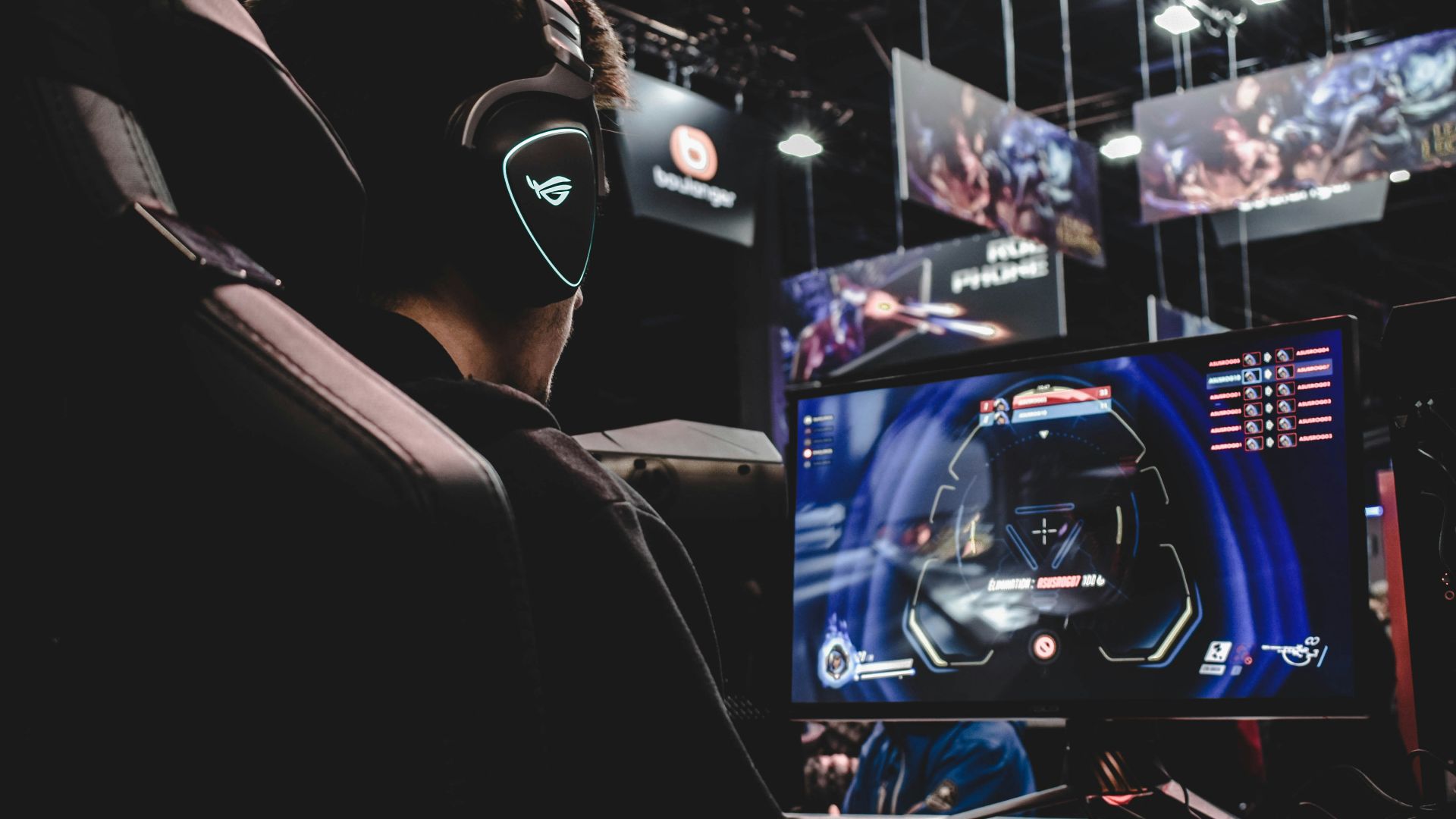
While flight simulators are a massive subgenre for aviation hobbyists, they were originally born from the close collaboration between arcade developers and military engineers. The consumer gaming market's constant demand for hyper-realistic physics and weather rendering forced flight software to become incredibly advanced. Today's commercial airline pilots log hundreds of mandatory training hours in advanced virtual cockpits.
 Kristopher Allison on Unsplash
19. Advancing Photorealistic Facial Recognition
Creating a custom gaming avatar that looks exactly like your real face requires highly sophisticated 3D scanning technology. The gaming industry's push to easily map your unique facial expressions onto digital characters forced massive leaps in mobile camera depth-sensing hardware. This rapid technological evolution directly paved the way for secure, instantaneous facial recognition systems.

20. Optimizing Global Content Delivery Networks
When a popular online multiplayer game launches a massive update, millions of players attempt to download gigabytes of data simultaneously without crashing the servers. To prevent global internet traffic from grinding to a halt, the gaming industry had to pioneer incredibly efficient content delivery networks and data compression technologies.