
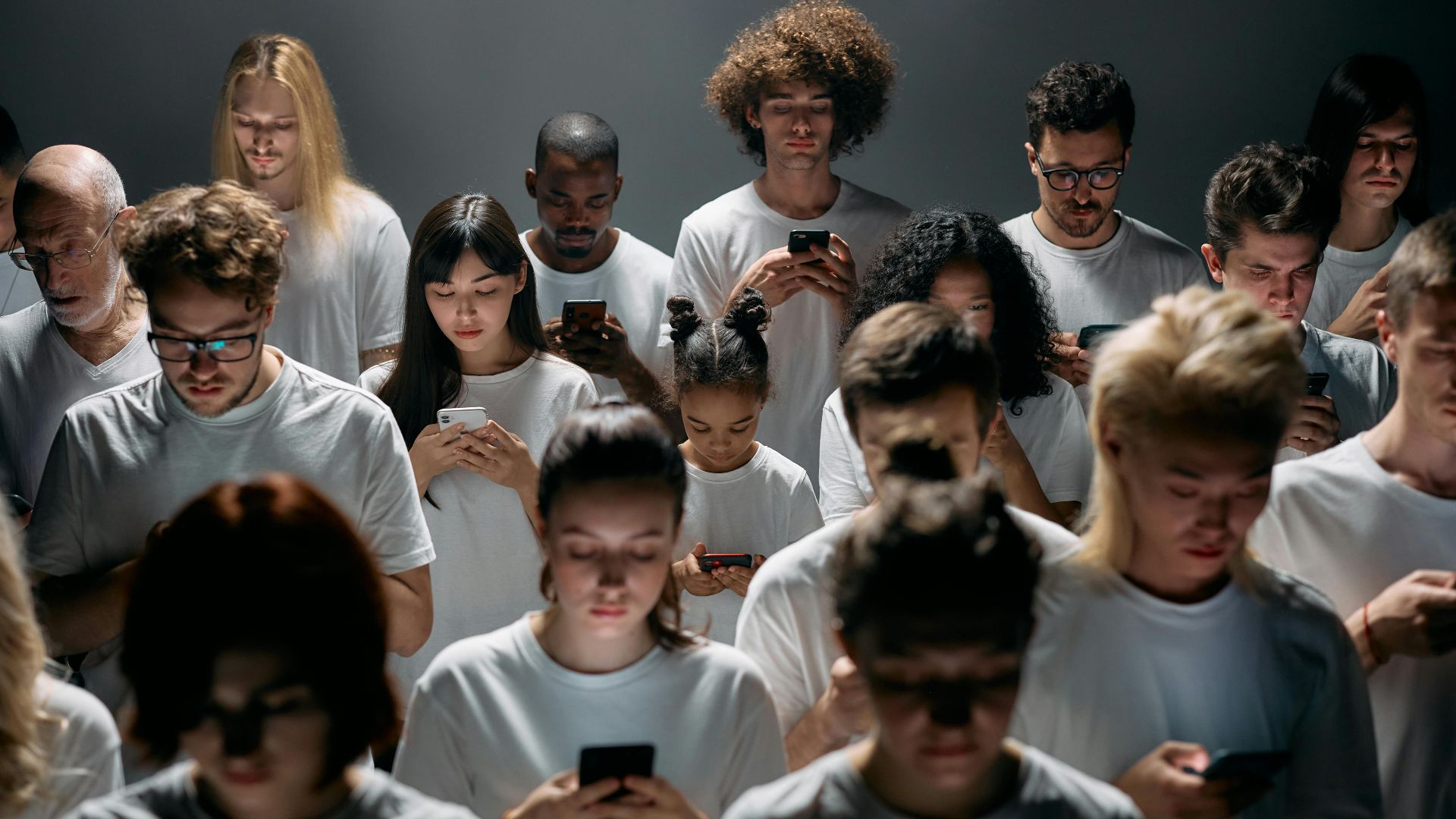
At some point you probably noticed that something had changed about how you read, watch, and move through information. A paragraph that would have taken two minutes now requires three attempts. A film you'd have sat with completely in 2012 now has you reaching for your phone during a quiet scene. You're not imagining it, and you're not uniquely broken. Something structural shifted, and most people felt it before they could name it.
The name for it, or at least the most useful one, is the attention economy. Attention became a commodity the moment platforms realized that screens could be used not just to deliver content but to maximize the time people spent in front of them. What followed was decades of systematic, well-funded engineering aimed at capturing your focus and converting it into revenue. The systems won. Now we're all living inside the aftermath.
It Was Engineered to Be Irresistible
The conceptual groundwork was laid early. Economist Herbert Simon wrote in 1971 that a wealth of information creates a poverty of attention, framing scarcity of focus as the defining constraint of the information age. Michael Goldhaber developed the economic logic further in a 1997 Wired essay arguing that attention would become the primary currency of the networked world. What neither could have fully anticipated was how precisely and aggressively that prediction would be monetized.
The engineering of addictive digital products has been documented extensively, most accessibly in Tim Wu's 2016 book The Attention Merchants, which traces the full arc from early advertising through the social media era. Platforms weren't designed to be useful and then discovered to be addictive. The addictive qualities were refined deliberately, using variable reward schedules that behavioral psychology had been studying since B.F. Skinner's mid-century research on intermittent reinforcement. Scroll long enough, and you understand what the rat in the experiment feels like.
B.J. Fogg's Persuasive Technology Lab at Stanford trained a generation of designers in the specific mechanics of behavior change, and many of those designers went directly into consumer technology. Nir Eyal's widely read book Hooked, published in 2014, laid out a four-step model for building habit-forming products that functioned as a product development manual across Silicon Valley. The tools for capturing attention were not accidental byproducts of useful technology. They were the product.
What It's Done to the Way We Think
The most documented effect isn't addiction in a clinical sense. It's fragmentation. Gloria Mark, a professor of informatics at UC Irvine who has spent years studying attention in digital environments, found that after an interruption, the average person takes 23 minutes to return to a task with full focus. In an environment where notifications, feeds, and alerts arrive continuously, sustained concentration becomes genuinely rare. The environment was designed this way, and most of us are working inside it for the majority of our waking hours.
Johann Hari, whose 2022 book Stolen Focus drew on interviews with leading researchers in attention and cognitive science, documents how the collapse of deep focus has effects well beyond productivity. The ability to stay with a problem long enough to think it through, or to read a long argument in full without switching tabs, is foundational to most serious thought. When that capacity erodes gradually, many people mistake it for a personal failing or early aging rather than recognizing it as an environmental effect.
The cognitive science on this is fairly consistent. Attention is both trainable and degradable. Constant low-level stimulation, frictionless switching between inputs, and the operant conditioning of likes and engagement metrics train the brain toward shallower processing over time. The capacity for sustained concentration has become rare and valuable precisely because the conditions most people live in make it so difficult to maintain.
Getting Out Is Harder Than It Looks
The options most people reach for first, the digital detox, the app timer, the phone-in-a-drawer approach, aren't wrong exactly, but they mislocate the problem. Individual willpower applied against systems built by thousands of engineers whose explicit job was to defeat that willpower is a deeply uneven contest. This is what makes the attention economy different from most consumption habits. The product actively resists being put down.
What the research does support is that structural changes work better than willpower-based ones. Removing apps from your phone entirely rather than limiting them, keeping devices out of the bedroom, and creating environments where distraction is physically inconvenient rather than merely discouraged all produce more reliable results. The friction has to be external, because the internal friction, that vague sense that you should probably stop scrolling, has been carefully engineered around.
The most honest version of where we all currently stand is that there is no clean exit. The communication infrastructure, the news, the professional tools, and the social fabric are woven into attention-harvesting platforms now. What's available is negotiation rather than escape, a conscious, ongoing renegotiation of how much of your focus you're willing to trade and for what return. That's a less satisfying conclusion than a five-step solution. It also happens to be true.